Chinese miners are expanding copper and gold output into this supercycle. Western miners are contracting. This is not a story about state policy or subsidy — it is a story about equipment, ore grade, and capital cost. And about Western miners now choosing Chinese mining equipment too, when given a free choice.
This is the price signal that textbook commodity economics says should bring production online. Rising prices → new mine development → more supply. The most basic feedback loop in the industry.
Only half of the industry is responding.
Chinese miners expanded copper output 16% over two years. Western miners contracted 18%. On gold, Zijin grew 43% while Newmont, Barrick, and Freeport each shrank 22–60%.
In a normal cycle, rising prices bring supply. In this cycle, rising prices are only bringing Chinese supply.
The West is running out of good rock (by Western standards)
Western majors cannot expand production into this supercycle. Three reasons, all variations of the same problem: the rock is worse than it was, and their operating model does not work at worse rock.
Grade is falling globally. Average copper ore grade has fallen from 1.6% (1990) to 0.45% today. Morenci in Arizona, Escondida in Chile, Grasberg in Indonesia — the Western flagship mines — are working progressively into the tail of their orebodies. Each tonne of copper requires more rock moved than it did a decade ago.
Discoveries have collapsed. Global new copper discoveries are down 80% from the 1990–2010 average — from ~50 Mt per year to ~8 Mt per year. Over 200 copper mines are expected to run out of ore before 2035. Without new discoveries, future production is capped by what is already known.
Building a new mine in the OECD takes 10–15 years. Greenfield copper or gold projects in the Americas, Australia, or Canada face permitting, litigation, environmental review, and Indigenous consultation stages that push first pour a decade or more from discovery. A mine commissioned in 2026 was explored in 2012. Rising prices today produce no new metal until 2040.
At 0.45% grade with 10-year development cycles and Western operating costs, many orebodies that still contain copper simply do not pencil out. The rock is there. The economics are not.
Why do the economics not work? That is the next question.
If you can't mine it, China can.
Chinese miners are running the same cycle, in many of the same countries, under the same physical geology — and they are expanding 12–22% over two years. The difference is operational capability. Four things Chinese miners can do that Western miners have shown they cannot:
Operate at lower grade. A mine at 0.30% copper grade that is marginal for Caterpillar-equipped Western operators is profitable for XCMG-equipped Chinese operators. At 0.17% grade — Julong, Zijin's flagship Tibetan copper mine — it is only profitable for Chinese operators. This is a capability constraint, not a choice. We get to the cost mechanics below.
Operate outside the OECD. Zijin operates profitably in Tibet, Kazakhstan, Serbia, DRC, Kyrgyzstan, Ghana. CMOC runs two of the world's largest copper-cobalt operations in DRC. These are not impossible jurisdictions — Kazakhstan in particular has an orderly mining regulator and a stable currency. Western majors simply do not have the on-the-ground operating experience, supply-chain relationships, or financing structures to run mines there. The expertise left the industry in the 2010s consolidation wave, and nobody has rebuilt it.
Acquire and restart orebodies Western miners wrote off. This is the story that will define the next decade.
The pattern: the same orebody, one owner writing it off, another expanding production from it. In every case the new owner is Chinese.
Finance mine development at 2–3%. Western miners pay 5-7% on debt while Chinese resource financing commonly runs 2–3%. This is because China enjoys structurally lower interest rates than the US. Over a 25-year mine life, a 400 basis-point discount-rate delta is worth 30–50% of project net present value.
The cost curve, in $/kg copper
The all-in sustaining cost (AISC) in mining is the cash cost to extract the resources — known as C1 in industry nomenclature — plus the maintenance capex required to keep the mine running.
Freeport's 2026 cash cost guidance is $3.86/kg. Barrick's is $4.85–$5.40/kg. Add maintenance capex and Barrick's all-in number lands at $7,600–$8,270/t of copper. At $11,500/t, Barrick's all-in margin is $3,230–$3,900/t.
Zijin's all-in margin on the same commodity is approximately $9,000/t.
This is why the supercycle looks like two different events to these companies.
Why is the cost so much lower?
Four factors stack together to produce a 60–70% delta.
Equipment cost. Chinese OEMs — XCMG, SANY, LiuGong, Tonly — sell mining trucks at 40–50% below Caterpillar and Komatsu prices on comparable specifications. A Cat 797F: approximately $3.4M. An XCMG XDE400 at the same 400-tonne payload: approximately $2.5M. Faster delivery, customisation included, local parts supply.
Capital cost, covered above.
Self-supplied power. Chinese operators increasingly bundle mine development with power infrastructure — the Heshima Hydropower Project at CMOC's DRC operations, dedicated solar plus battery storage at Chinese domestic mines, industrial-scale nuclear in the planning pipeline. Western miners pay grid rates ($0.08–0.15/kWh) or diesel generator rates ($0.20–0.35/kWh) for remote sites. Over a mine life, self-supplied clean power reduces operating costs by 15–25%.
Throughput design. Chinese mines are designed for high throughput at low grade from day one. Julong Phase 2 processes 350,000 tonnes of ore per day. Western mines have legacy plant sized for the higher-grade ore the orebody used to contain. Fixed costs amortised across more tonnes = lower unit cost per tonne of rock = lower unit cost per tonne of metal.
What is coming next — electric first, then autonomous
Crucial qualifier: the cost gap above is largely without electric and autonomous fleets deployed at copper mines yet.
Zijin's $2.05/kg cash cost is achieved with conventional diesel-electric fleets at Julong, Kamoa-Kakula, Čukaru Peki, and Bor. The full electric + autonomous + battery-swap + renewable-powered stack is currently deployed at coal, not copper. When it migrates to copper mines — which Chinese equipment makers are actively targeting — the Chinese cost curve drops another $400–$1,100 per tonne.
At 0.50% grade, both diesel and electric work; electric plus autonomy saves ~$557 per tonne of copper. At 0.17% grade, diesel is economically impossible — and the electric + autonomous fleet saves ~$1,640 per tonne of copper.
The lower the grade, the bigger the savings from going electric. Chinese miners are both investing in the technology and mining the ore where the technology pays out most. Western miners won't be touching the lower grade ores.
The western fleets have 15–20-year replacement cycles. Diesel trucks purchased in 2024 will still be operating in 2044. There is no catch-up path that does not require writing off existing capital.
The implication for Freeport, Barrick, and Newmont is uncomfortable. Even their most credentialed Western peer has concluded that Chinese mining equipment is the better value. They can follow Rio Tinto and concede the procurement relationship to Chinese suppliers, or they can stay with Caterpillar and pay the cost-curve penalty indefinitely.
Caterpillar's response — retrofit versus ground-up
Caterpillar is not standing still. 690 autonomous trucks in operation at end of 2024, target of 2,000+ by 2030. Partnership with CRH for battery-electric trucks. Multiple pilots.
But the architecture is fundamentally different.
Caterpillar retrofit: MineStar Command is an autonomy software and sensor layer added to existing truck designs. The chassis — 793, 797F, 794 AC — was designed for a driver. Cabin, HVAC, seat, climate control, pressurisation, dust filtration, sound insulation. The diesel engine remains. Electric trucks are a separate, earlier-stage development programme. Two parallel roadmaps with unclear convergence.
XCMG ground-up: The ZNK95 was designed cabless from first principles. No driver compartment eliminates cabin structure, HVAC, pressurisation, dust filtration, seat, operator controls. Weight savings redirected to larger battery and more payload. Electric only — no diesel option muddles the engineering. Integrated from day one with the Huawei 5G-A network, cloud dispatch, and battery-swap stations.
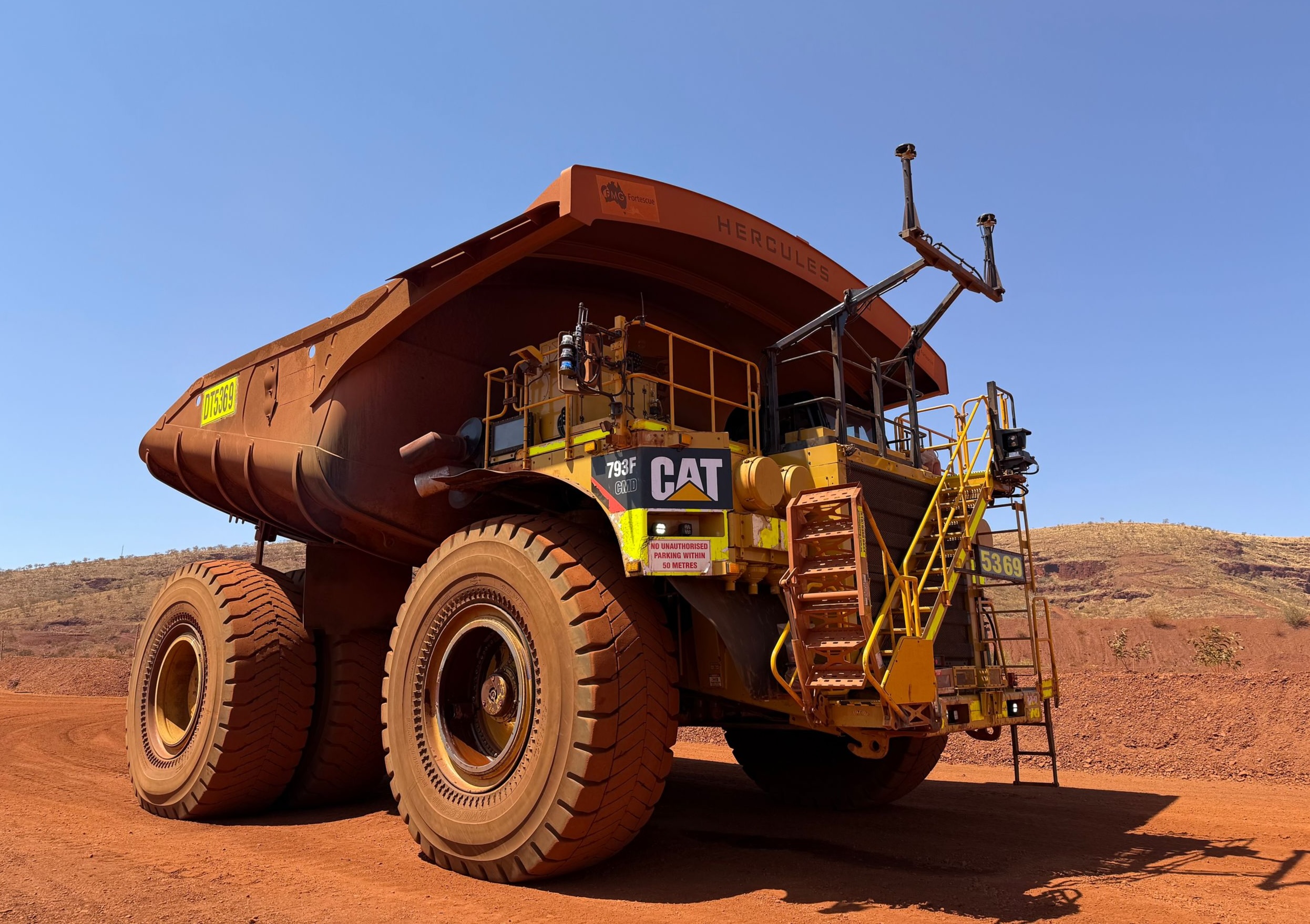
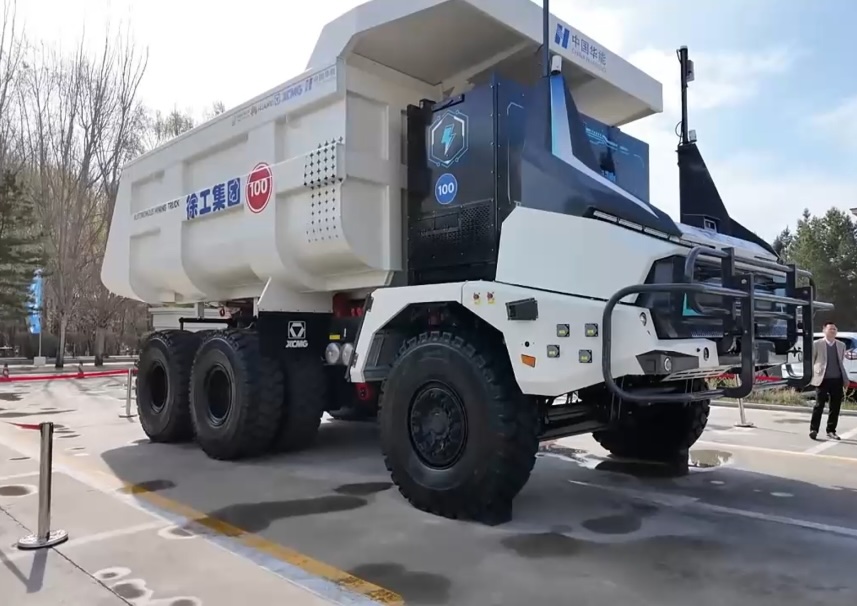
A Cat 793 with MineStar autonomy: approximately $3.5M all-in. An XCMG ZNK95 with equivalent autonomy and electric drive: approximately $1.7M. Caterpillar can match XCMG on autonomy software — and likely will within 3–5 years. It cannot match them on system cost without a ground-up chassis redesign, which means writing off decades of chassis design IP. The architectural debt is permanent.
The divergence
In 2026, the supercycle prints are historic: gold $4,700/oz average, copper $11,500/tonne, cobalt up 180% year-over-year. Zijin's 2025 net income was $7.4 billion — a record, up 60%. CMOC's was $3 billion — up 50%. Their 2026 production is guided higher again.
Freeport, Barrick, and Newmont all reported declining production at record commodity prices. Their unit costs rose. Earnings growth lagged the commodity move.
The Western mining industry today looks like the solar industry of 2012, the battery industry of 2018, or the electric-vehicle industry of 2022. The same pattern of category capture is playing out, driven by the same combination of cheap, powerful industrial base, electrification of the operating cost structure, autonomy eliminating the labour floor, and lower cost of capital.
Western miners, when given a choice, opt for Chinese equipment.
The marginal tonne of copper has moved east. Western operators aren't incompetent; it's the industry that moved on. The new mining industry runs on a different chassis, a different power source, and a different capital structure - a Chinese one.
The supercycle is real, but not for them.
Get the next post by email. No spam.